Do employers value online learning?

July 06, 2023

Do employers value online learning?


Education was one of the many industries that had to adapt to COVID and offer distance or remote learning. Many traditional universities are exploring a variety of options for remote learning in the time of COVID-19 with some classes even transitioning to fully online. Meanwhile, entirely online degrees grow in both popularity and prominence. 

Given the importance and growth of online education, many learners ask: Do (and should) employers perceive any difference in value between online and traditional education? Does an applicant with an online degree now stack up equally with a student who is learning online through a traditional university? And how does this vary by industry?

To find out, we conducted a survey of both hiring managers and employees that got their degrees completely online to gauge their opinions. Do hiring managers see these applicants as more or less qualified? And are online-educated applicants having an easy time in the job market? 

Hiring Manager Impressions of Online Education

Our study began by asking hiring managers about their perceptions of online education. They first shared their overall impressions and compared their opinions before and after the pandemic.
employer attitudes to online learning graphs

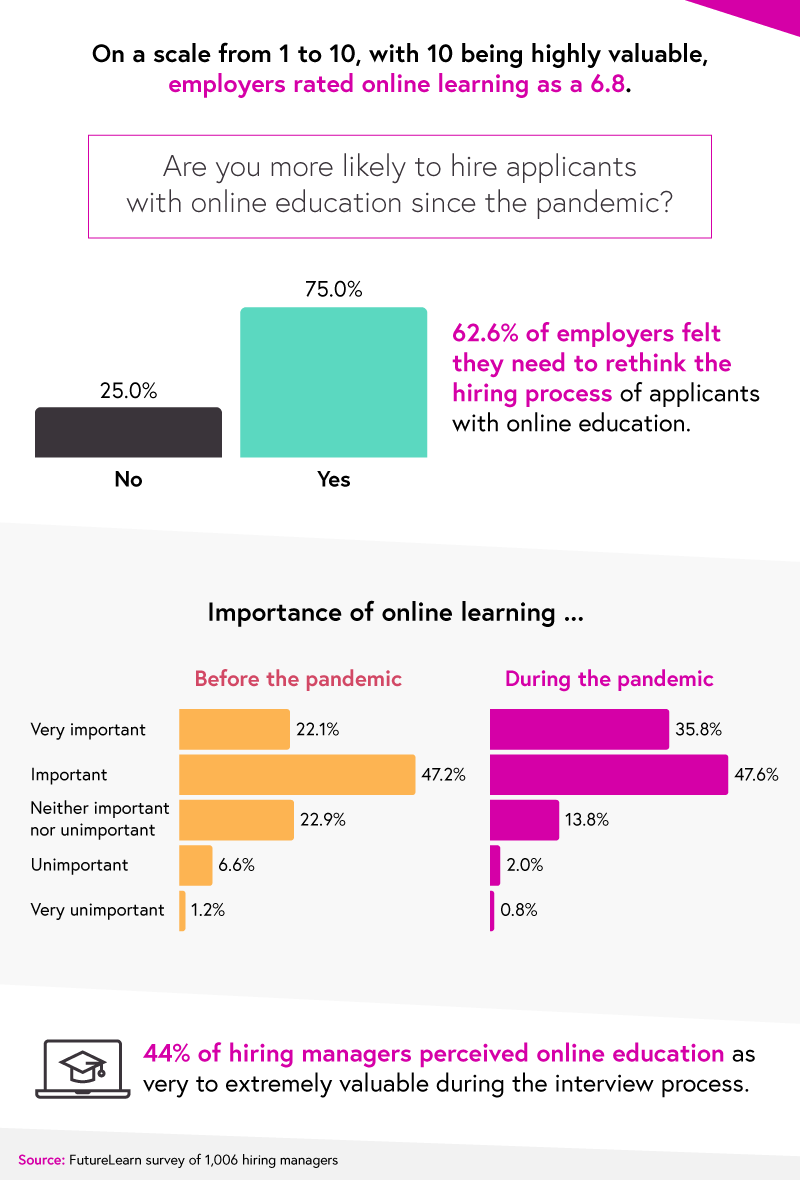
While some hiring managers were only slightly positive about online education (they rated it a 6.8 out of 10 on the value scale), most wanted to rethink this mindset – especially now. Three-quarters of hiring managers were more likely to hire applicants with solely online education today than they were prior to 2020. The pandemic may have worked to change attitudes towards the perceived value of online learning. 

Not only do hiring managers rate online education as more acceptable since COVID-19 but also as more important. This group was nearly 14 percentage points more likely to rate online education as “very important” during the pandemic than they were prior to the health crisis. Perhaps with even traditional students going online, the playing field has been leveled as far as impressions are concerned. 

Another 44% perceived online education as being extremely valuable to the interview process itself. Catalina Schveninger, Chief People Officer at FutureLearn and lead educator on the FutureLearn ‘Online Recruitment and Onboarding’ course, said, “We have witnessed some of the biggest disruptions to recruitment and onboarding processes throughout 2020, with remote hiring fast becoming the norm across almost all industries. That’s why it’s more important than ever for companies and candidates alike to be able to adapt to these new digitised practices and demonstrate their resilience and flexibility.” 
89% of employers believed online learning will be more common in the future

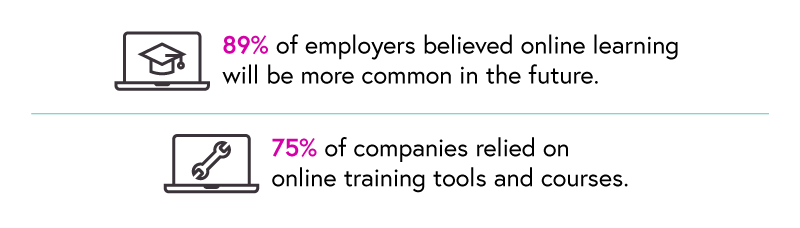
Even beyond the pandemic and its many restrictions, however, most employers (89%) still envision online learning becoming more and more common. After all, 75% of this group reported that they already rely on online training tools and courses to perform their own jobs. 

The Appeal of Online Education to Hiring Managers

Next we dug into the perceived benefits of online learning among hiring managers. They shared the most commonly valued traits they noticed among employees who had invested in their career through online learning. 
top perceived benefits of online learning

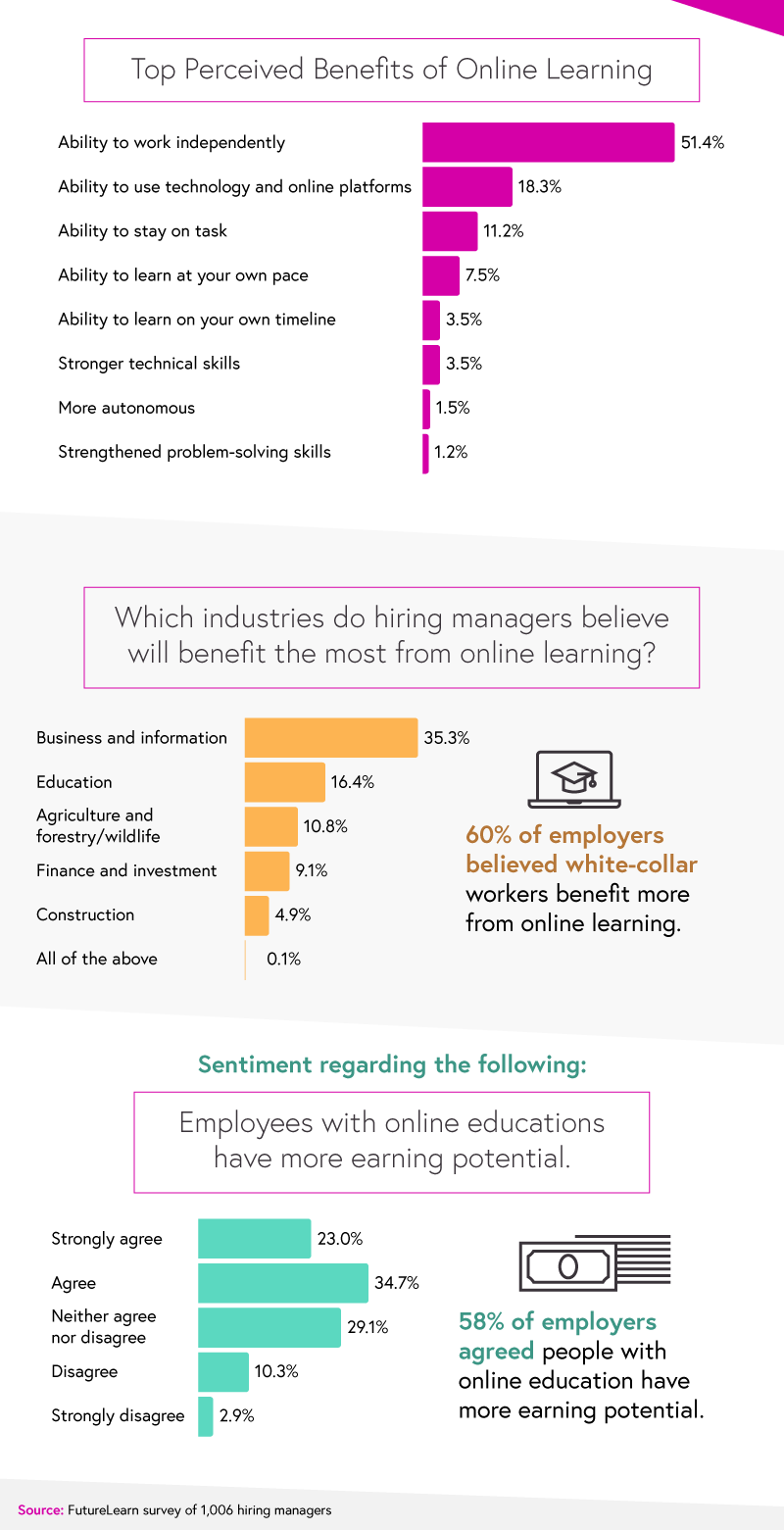
Hiring managers readily noticed an ability to work independently among online learners. This type of self-motivation is one of the most important skills an employee can have today, where so much of work (as well as education) has gone remote. Remote students and employees alike need to be able to be proactive without the constant reminders of a traditional office or classroom setting. 

18% of managers also appreciated the online learner’s ability to use tech and online platforms to get the job done. Note that tech is also a primary skill desired by today’s remote hiring forces. Remote hiring managers are currently seeking “people who are familiar with remote communication and collaboration tools because they’ll be able to come up to speed quickly in a new job,” according to Brie Weiler Reynolds of Remote.co. 

And when it came to earning potential? Online learners are officially thought to have more. This may be a reason why we’re seeing top-tier schools offering entirely online programs as well. 

Comparing Online Education to Traditional Experience

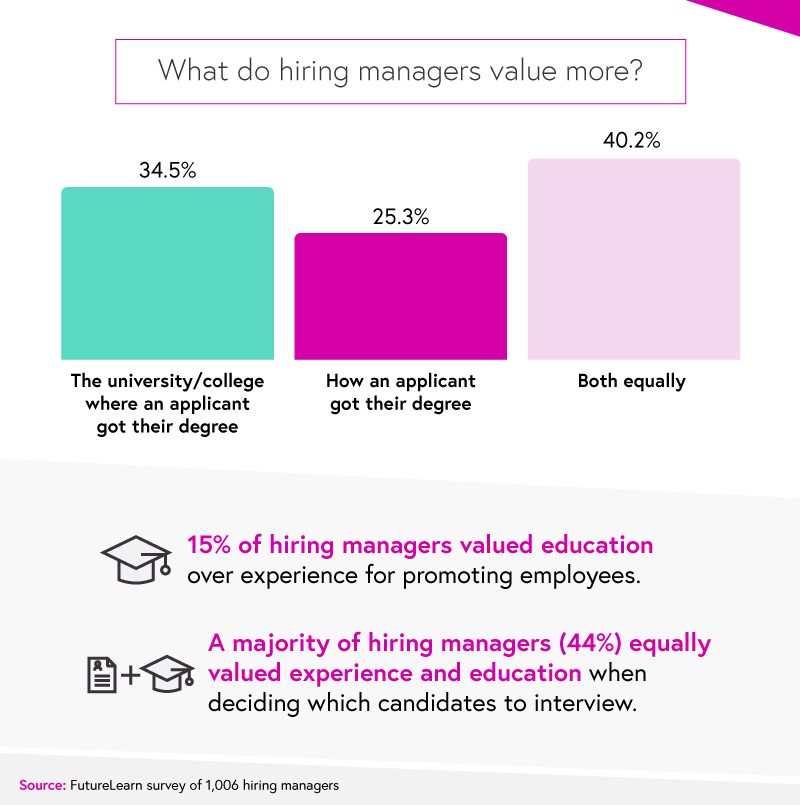
Next, we wanted to know if it was more important to hiring managers how an applicant got their degree or where. We also asked which mattered more in terms of interviews and promotions. 
what do hiring managers value more graphic

The name of the university an employee went to (whether online or in person) is still more important than how the person actually got into the school and obtained their degree. In other words, whether you went to the University of Michigan online or in person matters more than whatever incredible story got you into either program. 

Experience still mattered most. Most hiring managers did not value education over on-the-job-experience, though they were more likely to increasingly value education if it was just for an interview as opposed to an actual promotion. 
what employers value stats

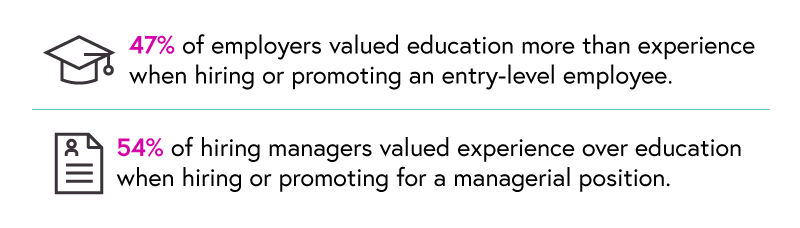
Hiring managers were willing to downplay experience when hiring for an entry-level position. 47% said the education mattered more to them than experience if the potential employee was just starting out. But once it came to promoting somebody already in the company, experience mattered more. 

Online Education on the Job

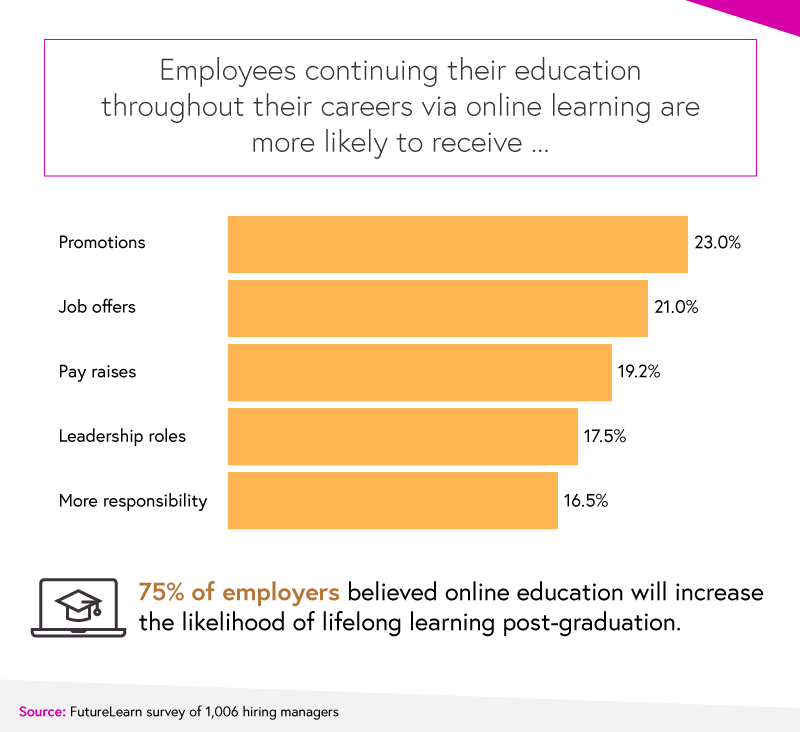
Another beauty of online education is that it doesn’t necessarily have to stop. Employees may pursue online learning in addition to their careers, if they choose. Online courses can offer the flexibility to work around schedules and timelines, while the resources obtained can prove invaluable to careers. The next part of our study asked hiring managers what types of things employees in continued online education were more likely to receive at work. 
career benefits of online education graph

As it turns out, employees who continued educating themselves online were more likely to receive all the good things: promotions (23.0%), pay raises (19.8%), and leadership roles (17.5%). Companies clearly value this practice in their employees. 

Many companies today even offer financial incentives for employees to learn online. Applying what you learn online to today’s remote workplace has also never been easier. According to our hiring managers, online education while on the job will prime you for some pretty lucrative and prestigious rewards. 

Showcasing an Online Education

A substantial portion of our respondents were already online degree-holders themselves. We next asked this subset how they listed their degree on their CVs, as well as how their application experiences typically went.
job hunting experiences for online learners graphic

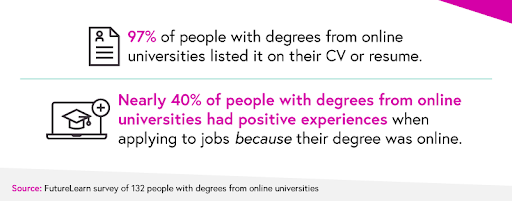
Online degree holders overwhelmingly opted to showcase the degree on their resumes. Just 3% did not. And with good reason: Nearly 40% of those with online degrees had more positive experiences when applying specifically because their degree was online. If you hold an online degree – or any certificate or training received online –  results indicate you should definitely put it on your resume. 

The Future of Learning

If you have spent time learning online, it’s certainly time to showcase it, now more than ever. Hiring managers demonstrated increasing interests in these types of employees and even increased the likelihood of rewarding them with raises and promotions on the job. 

If you’re new to the world of online education, take a look at the courses on offer at FutureLearn.  You can build new skills online with top educators and experts, receive credit towards a degree, or even complete a full degree online. 

Methodology and Limitations

This study uses data from a survey of 1,006 U.S. hiring managers and 132 people with degrees from online universities. The survey polled 1,006 U.S. hiring managers to provide a holistic view of online education’s value in the hiring and promotion process. The average age of respondents was 38 years, with a standard deviation of 11 years. 54.7% of respondents identified as male, while 45.3% identified as female. 

The main limitation of this survey is the reliance on self-report, which is faced with several issues including, but not limited to, attribution, exaggeration, telescoping, and recency bias. 

Fair Use Statement

Online education starts here – with the sharing of information. If you know someone who could benefit from the findings of this study, you are welcome to share it with them or your audience. Just be sure your purposes are noncommercial and that you link back to this page.
Learn more....

Browse Categories


LEARN MORE....


Your AI Career Coach: A Neural Network Design to Prepare You for a Career Change

July 06, 2023

Your AI Career Coach: A Neural Network Design to Prepare You for a Career Change

COVID-19 had a huge impact on employment in the US – while many people lost their jobs, others took the time as an opportunity to reflect on their careers and long-term goals. If you’ve been contemplating a career change, you’re not alone – according to FutureLearn’s recent Future of Learning report, 15% of millennials and Generation Z in the U.S., UK, and Australia have reevaluated their career path as a result of the pandemic – now is the perfect time to dust off your resume and level up your skills for a job in the future economy.

But how do you land that dream job? Deciphering exactly what skills hiring managers and teams are looking for can be stressful. But have you ever considered artificial intelligence as a resource for your job search? Research lab OpenAI has provoked chills throughout Silicon Valley with their latest AI text generator, GPT-3. FutureLearn’s team of forward thinkers put this revolutionary tech to the test by prompting it to provide online course recommendations for those looking to make a career jump.

From there, HR employees in industries ranging from tech to the medical field were surveyed and our team found that 59% of them think advice from artificial intelligence can help job seekers score the perfect gig, and another 63% think AI can provide useful job seeking advice to candidates. Read on to learn more about how FutureLearn used GPT-3 to generate career advice then asked real-life HR professionals for their thoughts on the generated advice and whether a candidate with those skills (and experience on their resume) would do well in a job search. 

Soft Skills to Win Them Over

When looking at where our virtual adviser missed the mark in each industry, a majority of the skills were soft skills – or things that aren’t as tangible – like knowing mathematical equations, Excel formulas, or CPR. These skills are more difficult to quantify. We asked our AI consultant to provide us with some soft skills that all applicants, regardless of industry, should focus on exemplifying.

Graph of AI soft skill recommendations

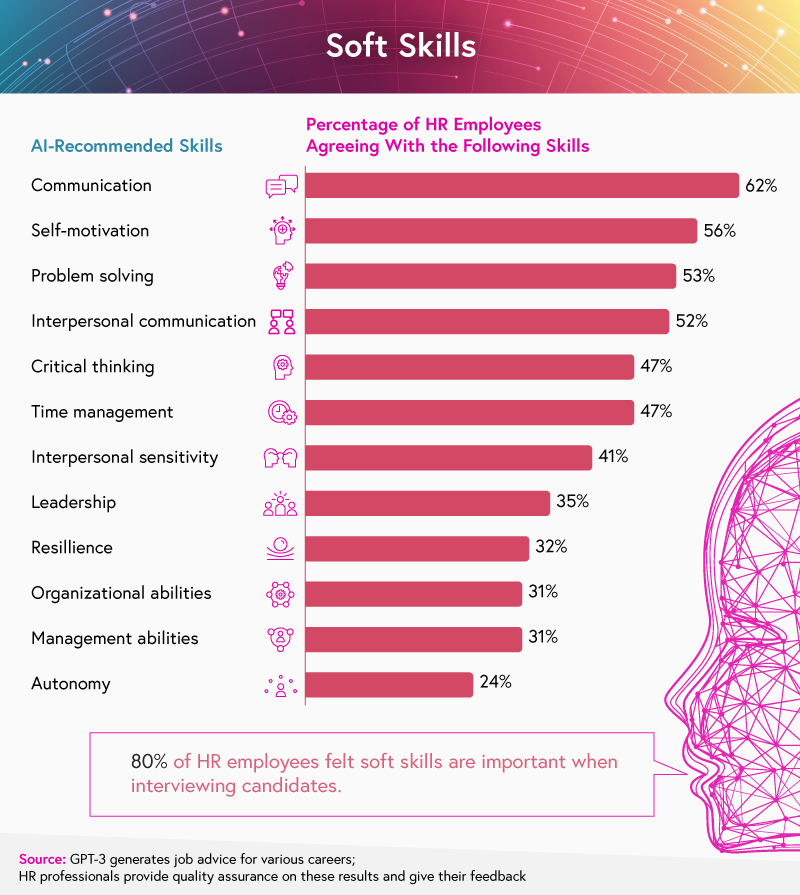
Our AI adviser said that communication skills were one of the most important soft skills you could have, and 62% of all HR employees we surveyed agreed. 

  • Only 24% of HR employees agreed autonomy was an important soft skill. In fact, many of the HR employees cited teamwork and collaboration as being important for candidates. 
  • Motivating yourself was a skill that 56% of HR employees found important, perhaps due to the evolving work environments over the last year.
  • Less than half of HR specialists found critical thinking, time management, interpersonal sensitivity, leadership, resilience, organization, management, and autonomy to be essential for applicants. 
  • In 2020, LinkedIn released a list of soft skills that employers were looking for. LinkedIn’s top 5 skills were related to how we work with other people, which ties back to our AI adviser suggesting employees have strong communication, problem solving, and interpersonal skills. LinkedIn also said that emotional intelligence was among the top 5 soft skills employers are prioritizing. Our AI bot suggested this, too (interpersonal sensitivity), and 41% of HR specialists agreed. 

Soft skills can be difficult to learn, and finding a place to build these skills can be difficult. But, our AI adviser suggested online courses were a great way to level up your abilities, not only for soft skills but in terms of hard skills, too.

Comparing Human vs. AI Advice 

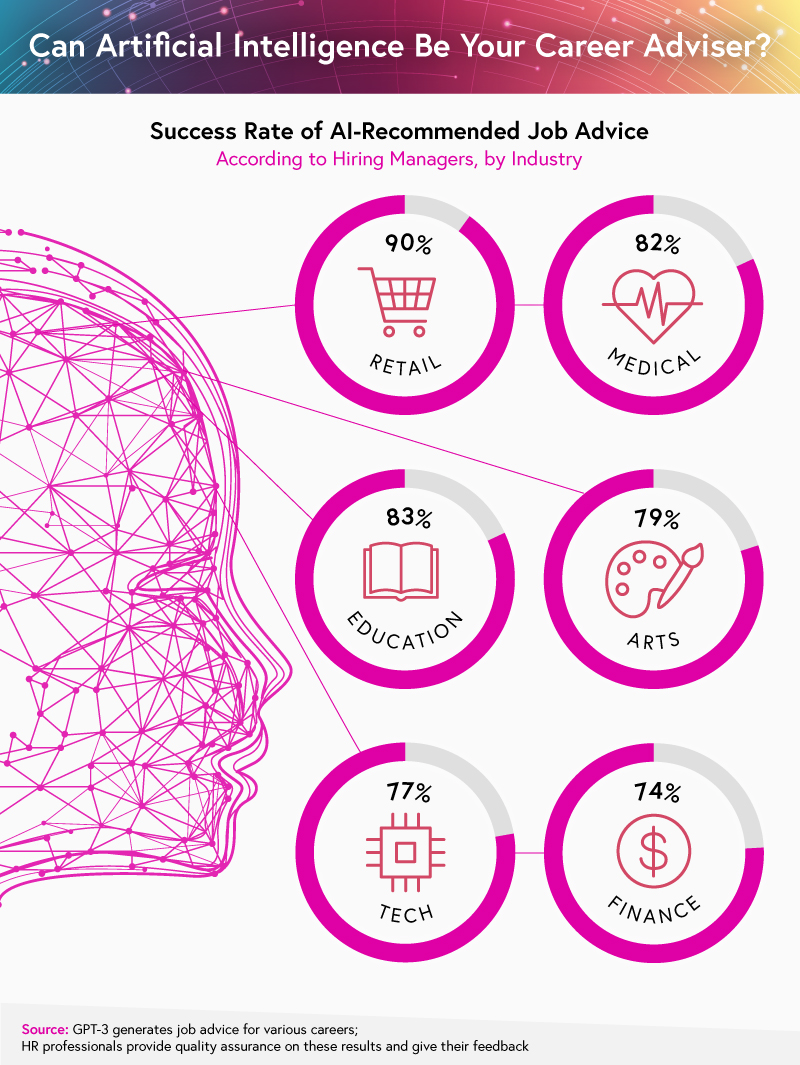
This chart explores the success of job advice given by artificial intelligence. We took the advice that was generated by GPT-3 specific to each of these industries and cross-checked it all by HR professionals – asking them the likelihood a candidate would land an interview if they had the skills AI recommended. 

AI career advice vs. HR professionals

While none of the industries we explored reached a 100% success rate, the AI adviser was still able to win over more than half of the HR specialists in each field we queried. 

  • GPT-3 offered the most successful advice to people looking for jobs in the retail industry, according to HR professionals in this field. 
  • For advice pertaining to landing a job in the medical or education industries, 82% of advice was useful according to HR professionals in these industries. 
  • The advice related to landing a job in a political field was the least successful at a rate of only 69%.

Recommendations in Retail 

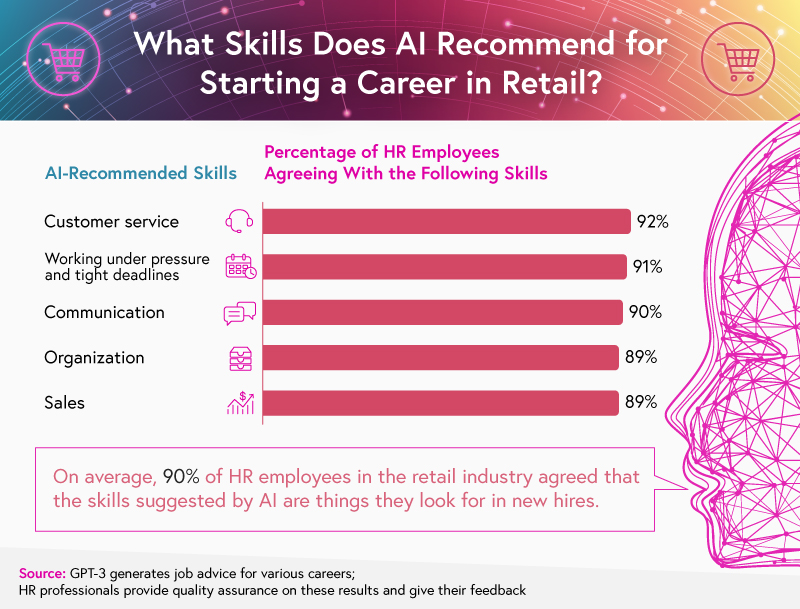
When it comes to the most successful advice, AI pretty much nailed what those searching for a job in retail should master. Ninety percent of HR employees agreed with the skills AI suggested. 

AI career recommendations for retail

Retail employees should be masters at customer service, working under pressure, communicating, organizing, and – of course – sales.

  • HR employees also wanted applicants to show patience, be a team player, and have a strong work ethic. Although not initially recommended by our AI adviser, these skills in conjunction with our AI’s advice could just land you the job you’ve been waiting for. 

Making It in Medical

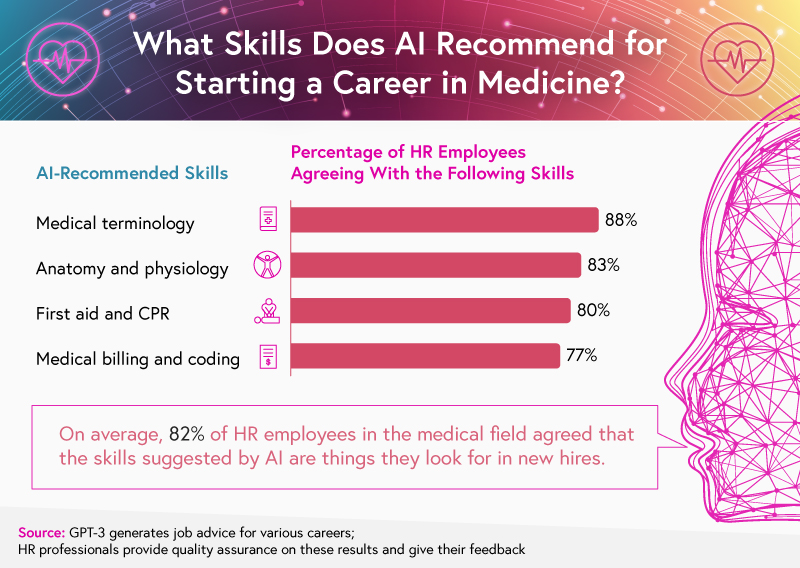
While medical education is important, there are also a few skills beyond formal training that medical HR specialists seek out. Hiring managers expect applicants in the medical field to show their people skills, such as compassion and patience. As far as AI, read on to find out what our virtual adviser suggested.

AI career recommendations for medicine

While AI missed the mark in suggesting more soft skills, it was spot on in recommending applicants know their medical terminology. 

  • 88% of hiring managers said knowledge of medical terminology is important for candidates.
  • Medical billing and coding were also important for candidates as were things like knowing parts of the body and life-saving techniques.

Entering Education

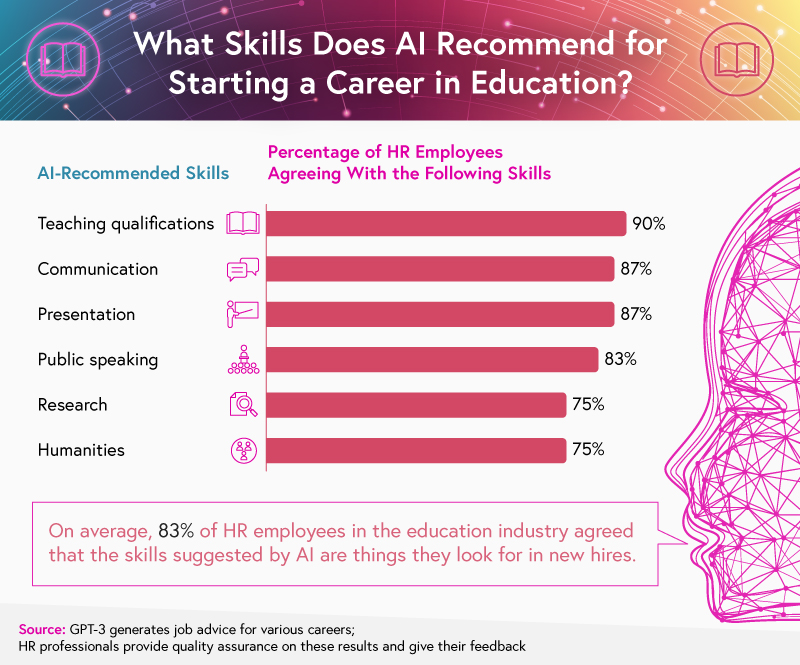
In the education industry, we found that, on average, 83% of HR employees agreed that the AI-suggested skills were ones they looked for in new hires, but 17%, on average, weren’t so sure. 

AI career recommendations for education/teachers

  • Even more so than the tech industry, 87% of HR specialists agreed with all of AI’s suggested skills. 
  • Communicating and presenting were key skills that those looking to break into the educational field should master and exemplify on their applications.

HR professionals agreed with AI when asked what skills they looked for – citing communication and teaching qualifications frequently. Hiring managers wanted candidates to show that they were patient and good at problem solving, two skills that weren’t initially recommended by our AI adviser. 

Entertaining a New Career

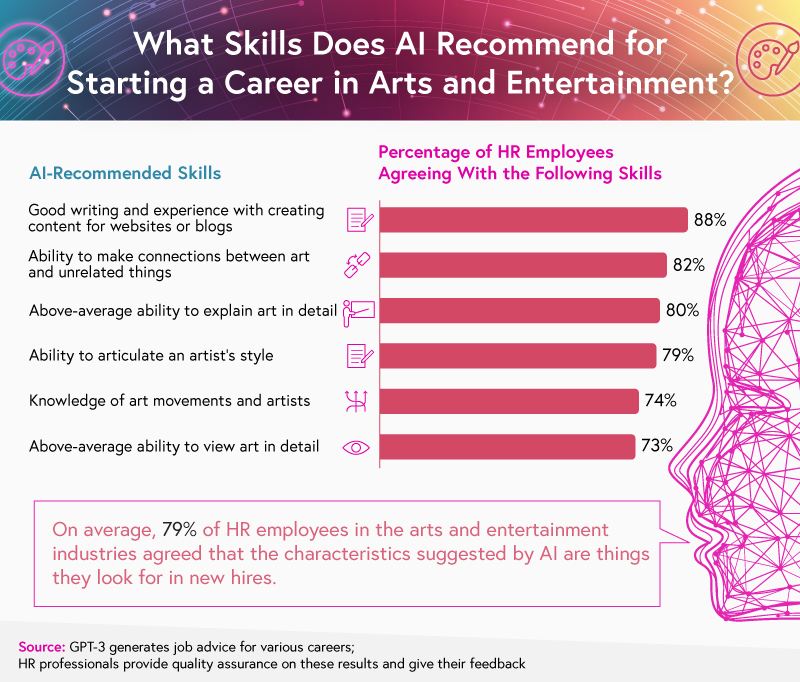
Arts and entertainment careers are attractive opportunities for creative types. For anyone looking for career tips to end up in this industry, AI was decent at suggesting skills. In fact, 79% of HR employees, on average, agreed with its advice. 

AI career recommendations for arts and entertainment

  • Strong writing skills and experience creating content were key for hiring managers, with 88% of them expecting to see these skills in an applicant.
  • Critical thinking and the ability to explain concepts were also important for these hiring managers. 
  • Flexibility was something that hiring professionals in this industry wanted to see but not something that our AI suggested. 

Transitioning to Tech

An example of the prompt provided to GPT-3 looked a little something like this: 

“To give yourself an edge over other candidates in this field, it is also recommended that you learn at least one new programming language every year.” 

From there we found that GPT-3 continued this prompt with the following skills:

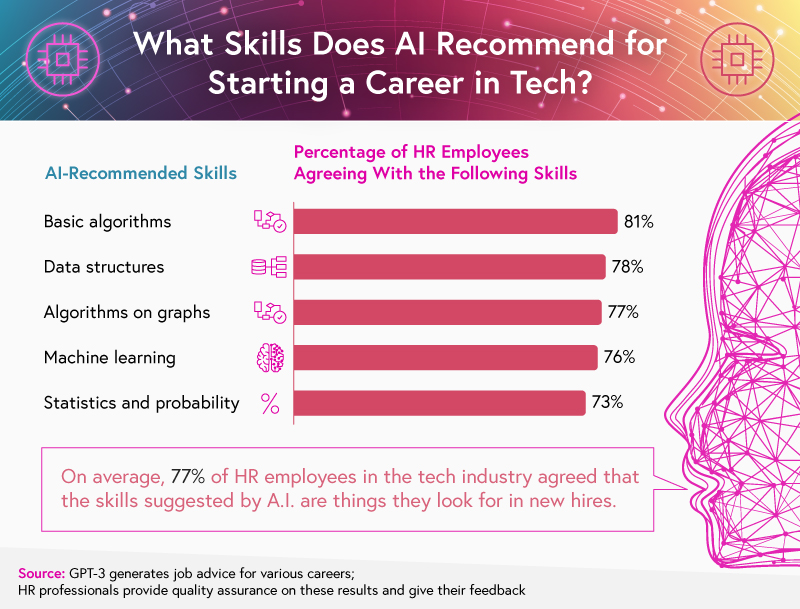
AI career coach recommendations for tech industry

Tech is a booming industry that people are looking to break into, and many need advice on where to start. Our AI adviser suggested skills in basic algorithms, data structures, algorithms on graphs, machine learning, and statistics and probability. 

  • Of the skills suggested by AI, more than 70% of tech HR specialists said they looked for these in new hires. 
  • HR specialists agreed and said basic algorithms, data structures, and tech algorithms were the skills in tech they looked for in new hires. 

Conversely, on average, 23% of HR employees didn’t agree with the skills that AI suggested for job seekers. Instead, HR specialists in the tech field said they wanted to see applicants with coding and programming languages under their belt, as well as communication and people skills.

A Future in Finance

Jobs in finance span across a variety of industries and serve a multitude of purposes. Mastering key skills in this field can be exactly what you need to stand out among the masses and land an interview for that dream finance job you’ve been eyeing.

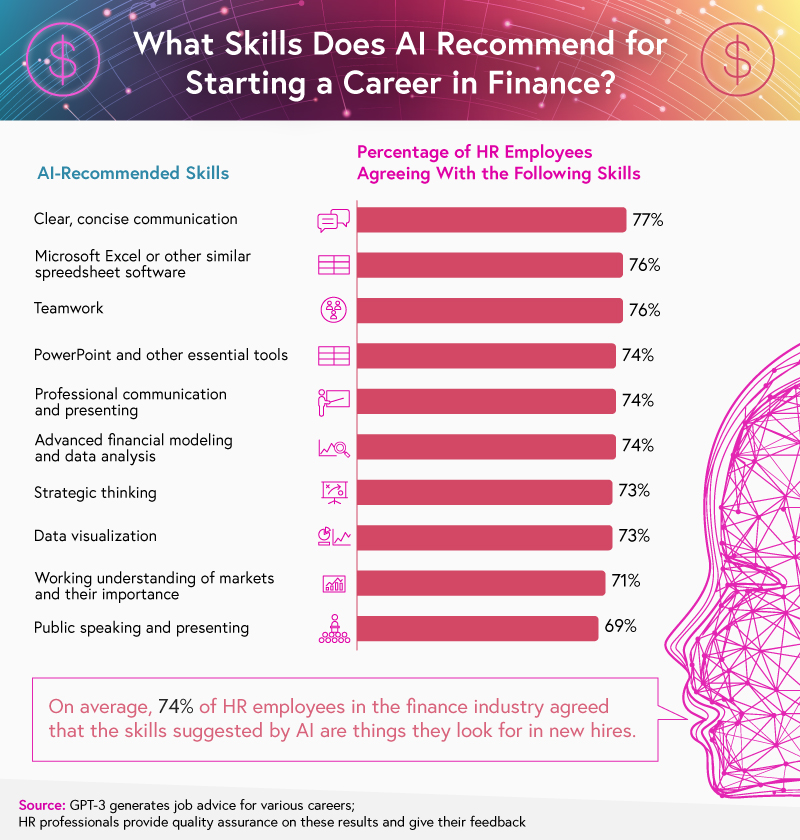
Ai recommendations for a career in finance

A common mistake many people make is that they try to get a job in finance without having any work experience. Job seekers can build up their experience through online courses to level up their skills before they embark on internships and personal projects that showcase their competence in key skills HR specialists look for. In fact, hiring managers frequently admitted to looking for training and education that applicants had completed when it comes to landing a job in finance. These skills were overlooked by AI but important to the people reviewing applicants. 

Here’s what AI did get right, though:

  • Communication is actually extremely important to those in the finance industry. This is likely due to having to explain complex numbers or formulas to people who may not know data as well as the person working with it.
  • Interestingly, working as a team was the second-most agreed-upon skill for those in finance as well, followed by having great Excel or Google Sheets skills.
  • A piece of feedback that has been consistent across industries so far is the importance of soft skills (interpersonal advice), like being able to “assess” and “communicate accurately.”

Landing the Job

We found that communication was a key skill regardless of which industry you work in, and teamwork was pretty important. No matter where you get your career advice, leveling up and reskilling is important to standing out in every field. Hanna Celina – Director of Insights at FutureLearn – remarked that “AI can be a powerful tool to help explore career options. It is a helpful way to be inspired about the variety of skills that are needed for a career, especially when planning a career pivot.”

“However, one should not forget that careers are as much about individual interest and passion as they are about employers’ expectations. Sometimes, differentiation with other candidates for the role can be based on a broad set of skills that are only tangentially related to the role. When you pick what you want to learn, try to find a sweet spot between skills that are highly marketable and areas that you are genuinely passionate about – this will help ensure you finish any courses you start and enjoy every day of your future working life.”

Once you’ve grown your understanding of in-demand skills and cross-referenced that with your own interests and experience, what next? Online courses are a great way to keep up with industry advancements and hone any skills, whether they be technical or soft. If you’re looking to fill a skills gap before applying to that dream job, FutureLearn has all of the needed tools and resources to help you achieve this. Our massive collection of online courses can help you explore new topics and skills you want to level up or learn more about. We can even help you hone those soft skills that hiring managers are looking for, too. Whatever you want to learn, whether professionally or in terms of a new hobby, there’s a course for you. 


Fair Use Statement

Know someone who could polish up their resume? Feel free to send this study to them. We just ask that you make sure to link back to this full study and only share for noncommercial use.


ads 728x90 B
Powered by Blogger.